

Woke Watch Canada is a reader-supported publication. Please consider becoming a paying subscriber or making a one-time or recurring donation to show your support.
By Nina Green
Are Marie Wilson, Kimberly Murray and Connie Walker undermining the Supreme Court of Canada decision on destruction of IAP records?
Let’s look at the evidence.
Connie Walker’s announcement
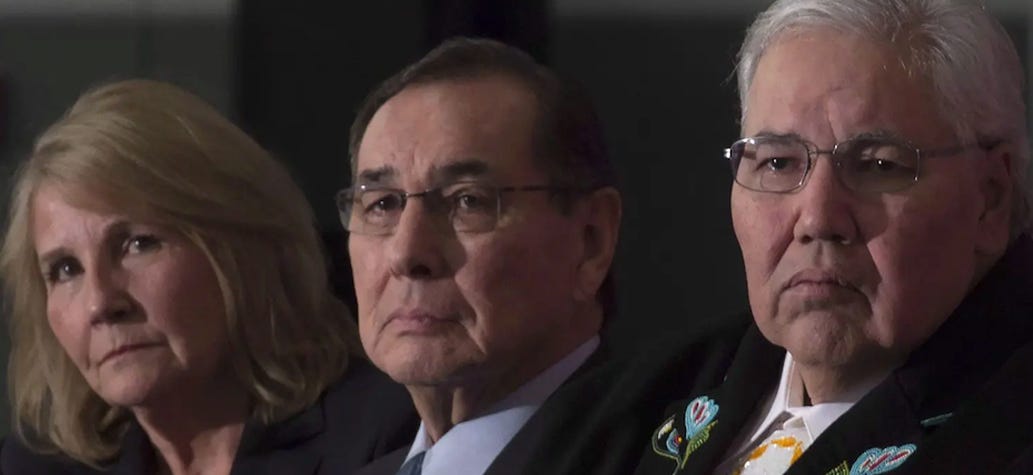
On 4 September 2026, former CBC journalist Connie Walker announced on Facebook that her Indian Residential School Records Project at Toronto Metropolitan University (TMU) will officially launch at an event on September 30th, the National Day for Truth and Reconciliation, with former TRC Commissioner and current member of the CBC Board of Directors Marie Wilson, and former TRC Executive Director and Special Interlocutor Kimberly Murray, as featured speakers.
The official launch appears to be a publicity stunt, as Walker’s project has been up and running for months according to a TMU article dated 10 March 2026. In the TMU article, Walker explains the origin of the project:
The project grew out of the second season of Walker’s podcast Stolen: Surviving St. Michael’s, which won numerous awards including the Pulitzer Prize and a Peabody Award. Blending investigative reporting with personal family interviews, the podcast tells the story of Walker’s late father, former RCMP officer Howard Cameron, and his time at St. Michael’s Indian Residential School in Saskatchewan - a school that ran for 100 years before closing in 1996.
“After learning for the first time in 2022 [sic] that my father was sexually abused by a priest as a boy at St. Michael’s, the podcast was initially an attempt to find out the identity of this priest and if he was ever held accountable,” said Walker.
Walker told the same story about her father at the sham Permanent People’s Tribunal in Montreal on 26 May 2026. In fact Walker was unable to corroborate the claim that her father had been sexually abused by a priest, and in her podcast Stolen: Surviving St. Michael’s, which was first broadcast on Spotify in 2022, and re-broadcast on the CBC’s The Current in August 2024, Walker falsely ‘identified’ and has forever blackened the name of an Oblate priest, Father Gilles Gauthier, who was not even in Saskatchewan at the time of the alleged incident involving Harold Cameron which forms the bedrock ‘evidence’ in Walker’s podcast. Rather than taking on new projects involving Canada’s former Indian residential schools, Walker should be apologizing to Canadians for the damage done by her podcast, Stolen: Surviving St. Michael’s.
The alarmist rhetoric in Walker’s Facebook post suggests that the 2017 Supreme Court of Canada decision is a disaster which requires intervention and management on her part. She writes:
. . . a year from now, the largest archive of Survivor records is set to be destroyed by order of the Supreme Court of Canada. . . .
The IRSR project aims to raise awareness about the impending destruction of Survivor testimony. . . .
We believe our project is an important and necessary intervention in these times that aims to work with Survivors, their families, and communities to decide how this history should be documented and managed. [bolding added]
Walker’s project is not ‘an important and necessary intervention’. It is an intrusion. The Supreme Court of Canada stated very specifically who was to manage IAP ‘Survivor testimony’, and it was not Connie Walker, Kimberly Murray, or Marie Wilson. The person the Supreme Court of Canada put in charge was the Chief Adjudicator of the Independent Assessment Process (see below).
The background to the Supreme Court of Canada’s 2017 decision that the records of the Independent Assessment Process are to be destroyed in September 2027
For those unfamiliar with the Independent Assessment Process (IAP), a bit of background might be in order.
As noted, in her Facebook announcement Walker says one of the two major aims of her Indian Residential School Records Project is to ‘raise awareness about the impending destruction of Survivor testimony’. What Walker is actually talking about when she refers to ‘Survivor testimony’ is the strictly confidential Independent Assessment Process (IAP) records which the Supreme Court of Canada has ordered destroyed in September 2027.
The Independent Assessment Process (IAP) was part of the historic 2006 Indian Residential Schools Settlement Agreement (IRSSA) negotiated by former Assembly of First Nations (AFN) Grand Chief Phil Fontaine. It was the mechanism by which former students received individual financial compensation up to $275,000 (see attachment) on a scale based on points for alleged physical, sexual or psychological abuse at Indian residential schools. Under the Independent Assessment Process, $3.2 billion dollars of Canadian taxpayer money was paid out to former students in order to (i) settle a flood of lawsuits which had been initiated by former students against the federal government and the churches, and (ii) achieve reconciliation (see Final Report, p. 88).

The Independent Assessment Process was governed by Schedule D of the 2006 Indian Residential Schools Settlement Agreement. It was designed as a claimant-centred process. In the vast majority of IAP claims, the claimant (a former Indian residential school student), his or her lawyer, and the adjudicator were the only active participants. The alleged perpetrators of abuse, 32% of whom were also former students, were not parties. Although described as ‘witnesses’ in Schedule D, in reality alleged perpetrators were merely private Canadian citizens tracked down by their own government and accused of crimes, but denied a criminal trial and the presumption of innocence. The alleged perpetrators could decline to participate, but if they elected to try to defend themselves, they were forced to engage in a process in which none of the normal rules of criminal procedure applied. In particular, an alleged perpetrator could not attend his accuser’s IAP hearing, or see a transcript of the accuser’s testimony. Because the process was costly, and alleged perpetrators were prohibited from properly defending themselves, few participated, with the result that the vast majority of alleged perpetrators were ‘found guilty’ in absentia, and the IAP records of those hearings consist of the claimant’s unsubstantiated and uncontradicted allegations. The only reason the lives of alleged perpetrators were not utterly destroyed by the IAP hearings is that strict confidentiality was built into the process. Hearings were closed to the public in order to protect the privacy of claimants; everyone involved had to sign a confidentiality agreement; and all records were to be kept strictly confidential apart from the claimant’s control over a copy of his or her own transcribed testimony for ‘memorialization’, which could also be ‘deposited in an archive developed for the purpose’ if the claimant chose to do that.
The Truth and Reconciliation Commission (TRC) lost the court battle over control of confidential IAP records
As mentioned above, the Independent Assessment Process (IAP) was governed by Schedule D of the 2006 Indian Residential Schools Settlement Agreement. Appendix II of Schedule D provided for the destruction of some, but not all, IAP documents at the end of the confidential IAP process. The omission of specific direction in Schedule D for the destruction of all documents became an issue when Murray Sinclair, Chairman of the recently-constituted Truth and Reconciliation Commission (TRC), requested by letter of 25 October 2010:
that the IAP provide all of its records to the TRC to assist with the overall goals of the Settlement Agreement to achieve truth, healing and reconciliation. . . . (See Paragraph 64 of the attached Factum of the IAP Chief Adjudicator dated 9 June 2014)
Understandably, the IAP Oversight Committee declined to accede to Murray Sinclair’s demand that it hand over to the TRC all the strictly confidential IAP records. Moreover the TRC stalled the IAP on the development of a plan for archiving the claimant’s copy of his or her own testimony if the claimant wished to do so, as provided in Schedule D. See Paragraph 51 of the Chief Adjudicator’s factum:
51. The Settlement Agreement provides that the adjudicator may request that a transcript be made of the evidence at the hearing. The claimant may request a copy of his or her own evidence “for memorialization,” and will be “given the option of having the transcript deposited in an archive developed for the purpose.” As described below, the TRC has blocked the Secretariat’s efforts to establish the consent programme required for such an archive. [bolding added]
Eventually, to resolve the impasse created by the TRC, the TRC and the IAP Chief Adjudicator, Dan Shapiro, both applied to the Ontario Superior Court of Justice in 2013 for direction. The TRC wanted all the strictly confidential IAP records handed over to it to be archived at the National Centre for Truth and Reconciliation (NCTR); the Chief Adjudicator wanted all the strictly confidential IAP records, with the exception of the claimant’s copy of his/her testimony, destroyed for the reasons he argued here and in the attached factum.
The case eventually reached the Supreme Court of Canada, whose 2017 decision (see attachment) summarized the decisions of the two lower courts on two issues: (1) the disposition of the IAP documents; and (2) the development of a notice program advising claimants that they could voluntarily archive their own personal IAP testimony with the NCTR if they chose to do so:
During the IAP, the Chief Adjudicator of the Indian Residential Schools Adjudication Secretariat and the Truth and Reconciliation Commission (“TRC”) brought requests for directions to the Ontario Superior Court of Justice on the disposition of the IAP documents at the conclusion of the IAP and, if necessary, on the development of a notice program to inform claimants of the possibility of voluntarily archiving some of their IAP Documents at the National Centre for Truth and Reconciliation.
The supervising judge found that the IAP records must be destroyed following a 15-year retention period during which individual IAP claimants could elect to have the records in their own file preserved. This order was substantially upheld by the majority of the Ontario Court of Appeal.
As noted, the lower courts held that the confidential IAP records must be destroyed after 15 years (i.e., in September 2027), but that individual claimants could elect to have a copy of their own personal IAP testimony preserved, and archived, if they wished to do so.
The federal government then stepped in and appealed the decision of the Ontario Court of Appeal, arguing that the supervising judge had no authority to order the destruction of the IAP records as they were government documents.
The Supreme Court of Canada unanimously dismissed the federal government’s appeal, explaining that the supervising judge (Justice Paul Perell of the Ontario Superior Court of Justice) did have the authority to order the destruction of the IAP records because of the key role assigned to supervising judges in the implementation of the 2006 Indian Residential Schools Settlement Agreement, and moreover that his decision was correct, because in practical terms, without the guarantee of confidentiality there would never have been any IAP hearings:
Judges of the provincial and territorial superior courts who certified the class action and approved the IRSSA were designated as supervising judges, and play a vital role under the IRSSA. They have administrative and supervisory jurisdiction over the implementation and administration of the IRSSA and can, among other things, hear requests for directions. In this case, the supervising judge correctly found that he had authority to make orders as to the disposition of the IAP Documents. The courts’ supervisory role in implementing the IRSSA allows them to make orders regarding the disposition of the IAP documents regardless of whether or not they are government records.
The supervising judge concluded, without palpable and overriding error, that the IRSSA allowed for the destruction of the IAP Documents. Both the text of the IRSSA and the surrounding circumstances support the supervising judge’s interpretation. The IRSSA’s express terms provided that the IAP Documents would be treated as highly confidential, subject to the very limited prospect of disclosure during a retention period, and then be destroyed. . . .
The supervising judge’s findings that the negotiators of the IRSSA intended the IAP to be a confidential and private process, that claimants and perpetrators relied on the confidentiality assurances and that, without such assurances, the IAP could not have functioned were inescapable.
In its decision, the Supreme Court of Canada drew attention to an affidavit filed by former AFN Chief Phil Fontaine on 1 May 2014. Fontaine fully supported the destruction of all the confidential IAP records. In his affidavit (see attachment), Fontaine stated at Paragraphs 16 and 17 that one of his primary objectives when he negotiated the 2006 Indian Residential Schools Settlement Agreement was to ensure that no one could identify a perpetrator by name outside the IAP process, and that strict confidentiality was built into the 2006 Settlement Agreement:
16. The solution to this and other problems was the confidentiality of the lAP process to ensure that no person could identify a perpetrator by name outside of the IAP process and everybody had to agree to that at the beginning of the IAP process. Furthermore, nobody except the survivor would have access to the story of the survivor. The IAP hearings were to be held in the strictest confidence.
17. This was built into the Settlement Agreement specifically by confidentiality provisions and requirements in the IAP process set out in Schedule D of the Agreement. [bolding added]
In Paragraphs 25-27 of his affidavit Fontaine emphasized the devastating consequences the archiving of confidential IAP records would have on Indigenous communities, in particular because 32% of IAP claims involve student on student abuse. As Fontaine famously told the CBC’s Barbara Frum in 1990, ‘The abused becomes the abuser’ (see attached transcript). Fontaine’s remark clearly suggests that a former student claiming abuse in his own IAP records might well be named in another claimant’s IAP records as an alleged perpetrator. Since claimants and alleged perpetrators of student on student abuse might be living in the same Indigenous communities after their time at residential schools, the disclosure of confidential IAP records was fraught with potential harm. As Chief Adjudicator Dan Shapiro stated (see SCC decision, Paragraph 47):
While the Secretariat and I take the confidentiality interests of all claimants and alleged perpetrators very seriously, the circumstances of student-on-student claims raise unique and heightened privacy and serious safety risks within First Nations communities if the confidential information were to be released, or even if there is a perception that the information may be released. It is not uncommon for such claims to be made against individuals from claimants’ own community. The potential for violence within communities and serious distress, including self-harm is heightened in these cases.
The Supreme Court of Canada echoed these concerns in Paragraph 47 of its decision, stating that:
And, as the spectrum of actions and harms that we have just recounted should make excruciatingly clear, disclosure of information contained in the IAP Documents could be devastating to claimants, witnesses, and families.
In Paragraph 24 of his affidavit, Fontaine emphasized that he wanted all his own IAP records destroyed.
24. I wish all those documents held by the Adjudication Secretariat, Canada and the Churches related to my IAP Application to be destroyed at the conclusion of the process. I understand that is what would occur in court litigation.
The Chief Adjudicator also referred to affidavits from former students who wanted all their IAP records destroyed in accordance with the guarantees of confidentiality they had been given, and without which they would not have participated in the IAP process (see Paragraphs 25-6 of his factum).
As well, the Supreme Court of Canada pointed out that had it not been for the guaranteed confidentiality of the IAP process, the churches would not have entered into the 2006 Indian Residential Schools Settlement Agreement:
[44] Confidentiality was also crucial to the participation of the church defendants. For example, the Chancellor of the Archdiocese of Halifax-Yarmouth stated that the assurance of confidentiality of all the IAP Documents was a vital inducement to his archdiocese entering the agreement. The former General Superior of the Congregation of the Sisters of St. Joseph of Sault Ste. Marie emphasized that, by participating in the IAP, her congregation relinquished the right to seek to preserve its reputation and that of its members by challenging the allegations of accusers in court, adding that it would not have done so were there the slightest possibility that information disclosed within the IAP information could become public. [bolding added]
The Supreme Court of Canada placed the notification process under the control of the IAP Chief Adjudicator
For the foregoing and other reasons, the Supreme Court of Canada ordered that the confidentiality of the IAP process must be respected, and that all IAP records must be destroyed in September 2027 apart from a claimant’s individual copy of his or her own testimony if he/she chose to preserve it for personal use, have it archived at the NCTR, or both.
The Supreme Court of Canada put the IAP Chief Adjudicator firmly in charge of notifying claimants that they had a choice about whether to allow their personal testimony to be destroyed, or have it archived:
[62] . . . The destruction order is subject to a 15-year retention period, during which claimants may choose to have their IAP Documents preserved and archived. That choice will be brought to the attention of claimants through a notice program administered by the Chief Adjudicator. . . .
[63] . . . The notice program should be carried out by the Chief Adjudicator, as it does not fall within the mandate of either the TRC or the NCTR, and as it would be inconsistent with a confidential process to provide them with the information necessary for the program. . . . [bolding added]
The TRC and NCTR were thus directly prohibited by the Supreme Court of Canada from having anything to do with the notice program, i.e. with ‘raising awareness’. Despite this prohibition, the NCTR does have a page on its website.
A CBC article in 2019 specifically mentioned the steps taken by the Chief Adjudicator to notify all IAP claimants that they could obtain a copy of their own testimony for personal use, have a copy of their own testimony archived with the NCTR, or both. These steps included a website, My Records, My Choice, as well as other initiatives:
“We have developed a robust notice program that includes training of health support workers across the country, paid advertising, social media, earned media, and other tools,” Dan Shapiro, chief adjudicator of the independent assessment process, said.
In a CBC article on 7 May 2025, IAP Adjudicator Kathleen Keating stated that she spoke with hundreds of IAP claimants who were afraid their testimony would become public, and were promised that it would remain confidential:
IAP adjudicator Kathleen Keating, who started with the IAP when it began in 2003 (then called Alternative Dispute Resolution) and was there until it finished processing survivors’ claims in 2021, said she spoke with hundreds of survivors who were afraid their testimony would become public.
She said adjudicators would often travel to meet survivors outside of their communities to preserve their privacy and remembers reassuring survivors by demonstrating her password-protected tape recorder, highlighting security measures taken with her filing cabinet and even explaining how her paper shredder worked.
“I can remember people who threw up in a waste basket in the hearing room at the thought of sharing these stories,” she said, adding she personally promised people their testimony would stay confidential.
Keating described the extraordinary efforts made by the IAP to notify claimants of their options:
Keating said the Supreme Court ordered a two-year multimedia campaign to let survivors know what they could do with their IAP files. The campaign included print, television, radio and social media ads, as well as information phone lines and a website.
Additional efforts to reach survivors included information packages and posters sent to band offices, friendship centres, correctional facilities and other stakeholders. Since 2021, the only part of the notification program still operating is the website.
“If you look at the notification program, I don’t know what else could have been done,” Keating said.
It seems clear that because of these extraordinary efforts claimants were long ago aware of their options, and that like AFN Chief Phil Fontaine, the vast majority of IPA claimants want all their confidential IAP records destroyed, including their own personal IAP testimony. In 2025, eight years after the Supreme Court of Canada decision, and after a massive campaign to notify claimants of the options available to them, out of 38,000 IAP claimants, fewer than 100 had elected to have their confidential personal IAP testimony archived with the NCTR. This is no doubt a cause of chagrin to the NCTR, but the Supreme Court of Canada gave claimants control over the disposition of their own personal testimony, and the NCTR must respect their individual decisions.
Connie Walker, Kimberly Murray, and Marie Wilson’s disagreement with the Supreme Court of Canada decision
When the Supreme Court of Canada’s decision was released in 2017, Assembly of First Nations Grand Chief Perry Bellegarde (to whom Connie Walker appears to be related through her maternal grandfather, Harry Bellegarde), declared the AFN’s support, calling the court’s decision ‘good and fair’, and stating further that:
Many former students shared their stories on the understanding that the IAP hearing was private and confidential. This must be respected.
Walker disagrees that the confidentiality of IAP records must be respected. By her own admission she tried repeatedly to get people connected with the IAP process to break the confidentiality agreements they had entered into. At a hearing held by the sham Permanent People’s Tribunal in Montreal on 26 May 2026, Walker played an audio clip from Episode 7 of her 2022 podcast Stolen: Surviving St. Michael’s which was broadcast by the CBC on The Current in 2024 (see attached transcript). The clip reveals that, acting on a hint from the TRC’s Director of Statement Gathering, Ry Moran, Walker tried to get individuals to reveal information from IAP records:
Voice of former Director of Statement Taking for the TRC, and former NCTR Director Ry Moran]
There’s records that exist, but they’re hidden, and they’re really hard to get at. . . .
[Voice of Connie Walker]
Ry says that outside of information from the Oblates, the next biggest help to our investigation would be records from the Independent Assessment Process. We don’t know how many were from St Michael’s, but remember, thousands of survivors went through the IAP, describing their experiences, and often naming their alleged abusers. If they made allegations against priests at St Michael’s, it would be in their IAP records.
[Voice of Ry Moran]
Basically right now, somewhere in this country, we know, we know collectively who the abusers are in the residential school system. We know exactly who they are, and we actually know exactly where they live.
[Voice of Connie Walker]
That’s the information I want, but those documents are sealed, and unless survivors ask to have them preserved, they’re going to be destroyed in five years. To date, only 28 survivors have asked to have their records archived with the NCTR. So all of the information, this massive record of abuse in residential schools, including the names of any priests who have been accused of sexual abuse, will be lost.
[Voice of Ry Moran]
I have seen some of this information, but I’m actually under like a sealing order still to this day by the courts that if I disclose anything, I’m in contempt, and can go to jail, and I’ve certainly thought about, you know, what that means. And it’s very complicated being in an organization like a truth organization, and having that type of restriction placed upon you.
[Voice of Connie Walker]
Ry can’t tell me what he knows, but he says he’s not the only one who has this information. There were other people involved in the IAP.
[Voice of Ry Moran]
You know, there are a number of lawyers, there are a number of adjudicators that did attend these IAP hearings. I mean, people that would be able to give you more information in terms of what was happening on the inside.
[Voice of Connie Walker]
So I called some of them up, adjudicators and lawyers who were part of the IAP, and private investigators who tracked down alleged abusers. Would any of them share the names of priests accused of sexual abuse during the IAP?
[Voice of Doug Racine]
What do I know about St. Michael Residential School? I know a whole hell of a lot. I can’t share a lot of it with you, because it was all, it was all secret.
[Voice of Eleanore Sunchild]
Those records would be with the church and they’re not, they don’t release them. But the Catholic churches are so tight-lipped, like, they’re so secretive.
[Voice of Glen (otherwise unidentified)]
I can’t tell you anybody that I contacted or located, I mean, because that would be going against my huge confidentiality agreement with the government.
[Voice of Connie Walker]
We hit dead end after dead end. . . .
It seems Walker’s efforts to get people to break the confidentiality agreements they had signed was unsuccessful, with the possible exception of Father Ken Thorson. See attached CBC transcripts of Episodes 6 and 7 of Walker’s podcast Stolen: Surviving St. Michael’s, and in particular, Episode 6:
CONNIE WALKER: And then a few weeks later, [Father Thorson] told me he’d asked around to Oblate priests and former staff, and that they weren’t aware of any claims against Gauthier either. So I sent Father Thorson the court documents with Ivan’s allegations. And then he wrote back with new information.
CONNIE WALKER: He said that a review of legal records from Oblate-run residential schools revealed that Father Gauthier was referenced in 23 IAP claims, and that 16 of those claims were deemed by the IAP to be credible allegations of sexual abuse against Father Gauthier.[bolding added]
It thus does seem that because of her lack of respect for the strict confidentiality of the IAP records and the Supreme Court of Canada decision, Walker was able to induce at least one person to breach IAP confidentiality.
Kimberly Murray and Marie Wilson also disagree with the Supreme Court of Canada’s decision. Murray, as Executive Director of the TRC from 2010-2015, and Marie Wilson, as one of the three TRC Commissioners from 2009-2015, fought for the TRC’s control of the IAP records all the way to the Supreme Court of Canada, and lost. Having lost, they now want to retry the case in the court of public opinion via the Residential School Records Project, and undermine public trust that the Supreme Court of Canada made the right decision in respecting the strict confidentiality that had been promised to IAP claimants.
Kimberly Murray has also publicly indicated that, like Walker, she does not accept the Supreme Court of Canada decision that the IAP records must be kept strictly confidential. In her final report to the Minister of Justice as Special Interlocutor, Murray mandated access by ‘independent reviewers’ to the confidential IAP records as one of the 42 Sacred Obligations she imposed on Canada (see Upholding Sacred Obligations, Vol. 2, p. 1326):
Independent Assessment Process Records
22. The federal government, in consultation and collaboration with Indigenous Peoples, must immediately appoint independent reviewers to review the records and testimonies of the Independent Assessment and Alternative Dispute Resolution processes. The scope of the review is to gather and report on information relating to the deaths and burials of any children prior to the court-ordered destruction date in 2027.
It’s clear that Marie Wilson and Kimberly Murray should publicly disassociate themselves from the Residential School Records Project. They were in key positions in the TRC when it lost its bid to gain control of the confidential IAP documents, and in its decision the Supreme Court of Canada expressly prohibited the TRC from having anything to do with the notice program, which is no different from the ‘raising awareness’ program which Walker’s Residential School Records Project now purports to be undertaking. The Supreme Court of Canada decision specifically prohibits the TRC, and thus Marie Wilson and Kimberly Murray as former TRC officials, from having anything to do with a ‘notice’ or ‘raising awareness’ program regarding the IAP.
Connie Walker should also step away from the Residential School Records Project for the same reason. The Supreme Court of Canada placed the IAP Chief Adjudicator in charge of the notice program, i.e. the program to ‘raise awareness’ among claimants that they can obtain a copy of their personal testimony for their personal use, archive a copy with the NCTR, or both. Connie Walker cannot substitute herself and Toronto Metropolitan University students for the official the Supreme Court of Canada put in charge of that program. Walker should also step away from the Residential School Records Project because by her own admission she actively attempted to have people connected to the IAP process break their IAP confidentiality agreements while she was preparing her podcast Stolen: Surviving St. Michael’s, and in Episode 7 of her podcast, broadcast by the CBC in 2024, she also very publicly named more than two dozen other alleged perpetrators whose names are almost certainly included in IAP claimant files.
The CBC’s involvement
Connie Walker and Marie Wilson both had long careers as CBC journalists. Moreover in 2024 the CBC broadcast Walker’s podcast, Stolen: Surviving St. Michael’s, in which Walker freely admitted attempting to break IAP confidentiality agreements, and publicly named over two dozen alleged perpetrators whose names are almost certainly in confidential IAP records.
Moreover Kimberly Murray and Marie Wilson held positions at the highest level in the TRC, which lost in the Supreme Court of Canada in its bid to prevent the destruction of the IAP records. Wilson is currently a high-profile member of the CBC Board of Directors, and both Murray and Wilson are now involved with the Residential School Records Project which appears to be actively undermining public trust in the Supreme Court of Canada decision that the IAP records must be destroyed. Through Marie Wilson’s position on its Board of Directors, and its promotion of Connie Walker’s podcast Stolen: Surviving St. Michael’s, the CBC gives the appearance that it officially supports the breaking of IAP confidentiality agreements, the public naming of alleged perpetrators, and the undermining of public trust in the Supreme Court of Canada’s decision. If the CBC does not support those positions, it should publicly distance itself from the Residential School Records Project.
Thanks for reading. For more from this author, read Should the Permanent Peoples' Tribunal (PPT) withdraw from its Montreal hearings and apologise to Canada and Canadians?
Follow Woke Watch Canada on X: @WokeWatchCanada
Or, by contributing to our Donor Box:
This statistic is shocking: “32% of IAP claims involve student on student abuse.” There is no evidence that a student was ever charged or convicted, only adult staff.
More proof that it’s not about reconciliation but extortion. Controlling the narrative to rewrite the past.