

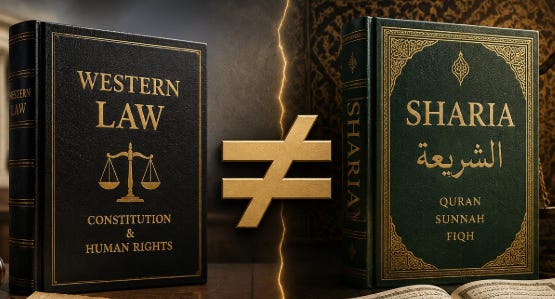
Woke Watch Canada is a reader-supported publication. Please consider becoming a paying subscriber or making a one-time or recurring donation to show your support.
For years we have been told that Islam is a religion of peace, that anyone who says otherwise is Islamophobic. But clearly something is not quite right with this. Anyone with eyes can see that Islam is expansionist, intolerant, and totalitarian. Western men turn away in disgust at the way Muslim men treat their women and children. And then of course there is the existential threat of global jihad (Islamic terrorism). But yet Western leaders (leftists) seem blind to the harsh realities of Islam as they insist it is a legitimate Abrahamic religion just as deserving of liberty as all the rest.
But what if our leaders are wrong? What if Islam has been misunderstood, or misinterpreted? What if, as Canadian researcher Elaine Ellinger posits in her 2026 volume The Deen Fallacy, Islam is not a religion at all, but a Deen — a “comprehensive system of submission and obedience to Allah governing worship, law, politics, economics, commerce, family life, personal hygiene, morality, and society.”
According to Ellinger, Western scholars made a serious error when initially translating Islamic texts (Quran, Hadith, and classical Islamic legal manuals). For years the word “Deen” was thought to be the same or similar concept as “religion.” It is not. From this mistranslation has arisen a fundamental misunderstanding of exactly what Islam is, and what Islam does?
I will be returning to Ellinger’s books soon — possibly for book reviews, or maybe just as sources for essays critical of Islam. Today however, I present an essay written by Ellinger which explores one of the reasons why Western democracies should rethink their permissive inclusion and embrace of Islam into a liberal democratic social order at odds with the obligations of Muslims.
Islamic Doctrine and Jury Service in Non-Muslim Courts
By Elaine Ellinger
An X contributor wrote: “They shouldn’t be on jury duty as they always let their cousins off.”
A common complaint in Western countries is that Muslim jurors should not serve because “they always let their cousins off.” The remark is usually treated as a crude accusation of favouritism toward other Muslims or dismissed as “Islamophobia.” In reality it points to a deeper and well-documented difference in legal and moral rules.
There is a further difference that Westerners often miss. In the West it is common to treat religion as something that can be largely ignored while still claiming the identity. Many people call themselves Christian while disregarding large parts of Christian teaching, and this is widely accepted. But Islam is a deen – a complete way of life and system of law – fundamentally different from personal belief.
A devout Christian or a devout Jew can fully practise their faith while remaining compatible with Western law. A devout Muslim, according to traditional doctrine, cannot. Sharia is not something that can simply be set aside while still remaining within the faith, at least not once it is fully implemented. To reject the obligation of Sharia is not treated as a private lifestyle choice; in classical teaching it risks placing a person outside the faith altogether. Sharia is active, not passive. What looks like ‘cultural’ or ‘moderate’ Islam is a temporary adaptation that precedes Islamic rule. The underlying doctrine remains in place, even if it is not applied while Muslims remain a minority.
Quran 4:65 “But no, by your Lord, they can have no faith until they make you [Muhammad] judge in all disputes between them, then find within themselves no discomfort from what you have decided and submit in full submission.”
Quran 5:44 “And whoever does not judge by what Allah has revealed - then it is those who are the disbelievers.”
Quran 33:36 “It is not for a believing man or believing woman, when Allah and His Messenger have decided a matter, to have any choice concerning their affair.”
Reliance of the Traveller (sharia manual) o8.7/14 (Apostasy) states that a Muslim commits apostasy by denying something that is necessarily known to be of Islam, including obligations established by consensus.
“Whoever changes his religion, kill him.” (Bukhari 6922)
For Islam, there is a theological objection to validating and operating a judicial system that does not implement Sharia. This objection applies to the entire ummah – the global nation of Muslims. It is not limited to jury service. The same problem arises with any role that requires a person to enforce, uphold, or legislate non-Islamic law – including judges, lawyers, prosecutors, and members of parliament.
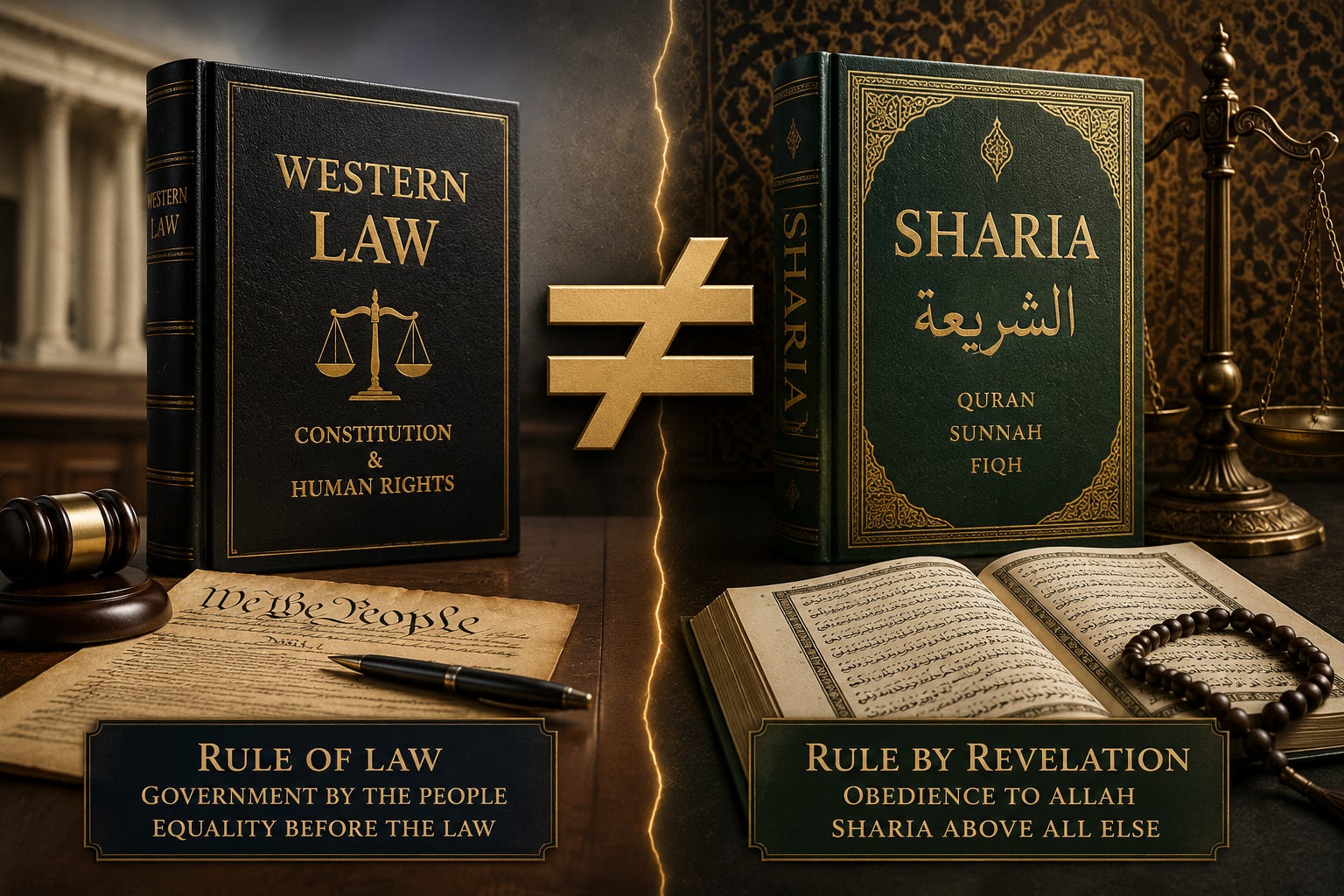
In that light, the real question is not whether Muslims show bias inside the jury room, but why they are being placed in a role that Islamic doctrine considers illegitimate to begin with. Allowing such participation carries a further risk: that it may be used strategically to advance outcomes more favourable to Sharia norms than to the principles of the Western legal system in which the jury is supposed to operate. Placing practising Muslims in these positions is therefore not a neutral act of inclusion; according to classical doctrine, it is inviting conflict between two incompatible systems of law and loyalty.
This concern is reinforced by classical teachings on alliances and precaution. Quran 3:28 states: “Let not the believers take the disbelievers as allies rather than the believers. And whoever does that has nothing to do with Allah, except when taking precaution against them in prudence…”
Ibn Kathir, in his well-known commentary on this verse, records the view that tuqyah (deception) is permitted until the Day of Resurrection.
According to Islam, Muslims should not serve on juries in non-Islamic courts in the first place. Participating as a juror means taking part in a system that judges by man-made law rather than by what Allah has revealed. Traditional scholars regard this as problematic because of texts such as Quran 5:44–47, which state that those who do not judge by what Allah has revealed are disbelievers, wrongdoers, and rebellious. The principle that sovereignty in judgment belongs to Allah alone reinforces this position. Many fatwas therefore discourage or prohibit Muslims from serving as judges or jurors in non-Muslim courts when an Islamic alternative is unavailable.
These verses mention the Torah and the Gospel. But classical Islamic teaching holds that the earlier scriptures were corrupted and are not reliable. The only uncorrupted and final revelation is the Quran. The obligation to “judge by what Allah has revealed” therefore means judging by the Quran and the Sunnah of Mohammed – not by the Torah or the Gospels.
This distinction matters because the verses are sometimes presented in a way that suggests Islam honours the Torah and the Gospels recognized by Jews and Christians. It does not.
A second set of teachings compounds the problem. Classical Islamic teaching places a high value on protecting the honour and unity of the Muslim community (the ummah). Quran 48:29 describes the believers as “severe against the disbelievers, merciful among themselves.” Other texts forbid backbiting, tale-bearing, and searching out or publicizing the faults of fellow Muslims except in very limited cases – mainly when that person is openly and actively breaking Sharia in a way that harms other Muslims or the ummah.
The same principles appear throughout the classical manuals. Reliance of the Traveller (Umdat as-Salik), the well-known manual of Sharia certified by Al-Azhar, discusses these matters in detail in its section on holding the tongue. Concealing the faults of a fellow Muslim is rewarded, and it is an enormity to “show others the weak points of the Muslims” (ROT w52.1 / 384).
Supporting texts include:
“The tale-bearer will not enter Paradise.” (Bukhari 6056, Muslim 105)
“Every one of my followers will be forgiven except those who expose (their wrongdoings) openly. An example of this is that of a man who commits a sin at night which Allah has covered for him, and in the morning he says: ‘O so-and-so, I committed such-and-such last night,’ while Allah had kept it a secret. During the night Allah covered it, but in the morning he tears open the cover provided by Allah Himself.” (Bukhari 6069, Muslim 2990)
“A Muslim is a Muslim’s brother: he does not wrong him or abandon him... and if anyone conceals a Muslim’s fault, Allah will conceal his fault on the Day of Resurrection.” (Abu Dawud 4893)
Quran 49:12: “do not spy or backbite one another. Would one of you like to eat the flesh of his brother when dead?”
Quran 104:1: “Woe to every scorner and backbiter.”
The well-known hadith defining backbiting: “It is to mention about your brother that which he would dislike... If what you say of him is true, you have backbitten him; if it is not true, you have slandered him.” (Muslim 2589)
The normal rule is therefore to cover a Muslim’s faults; exposing them is the exception, not the rule.
Taken together, these two sets of teachings – the duty to cover the faults of fellow Muslims and the rejection of non-Sharia courts – produce a way of thinking about right and wrong that is simply not the same as the Western one. Western legal culture assumes that every citizen has a common duty to report wrongdoing and to judge impartially according to the law of the land. Islamic doctrine does not share that assumption.
The practical result is predictable. When a Muslim is placed on a jury in a non-Muslim court, he is being asked to work inside a system whose legitimacy his own tradition rejects, while at the same time being bound by sharia that prioritises the protection of other Muslims. The Western observer who expects the same moral responses he himself has is therefore starting from a false premise.
Sadly, the West continues to assume that Islam shares its own moral and legal code. It does not.
(This post originally appeared on Elaine’s Substack Perspectives On Islam)
Elaine Ellinger is the author of:
The Deen Fallacy: How the West Came to Misclassify Islam. Cause, Consequence, and Correction (2026). The Deen Fallacy identifies a foundational error in Western thinking: the classification of Islam as a religion in the conventional Western sense. Mistranslation produced misclassification; misclassification produced defective policy. The book offers a coherent corrective legal framework.
The Hidden Curriculum of Islamic Schools: From Prayer to Sharia – A Child’s Indoctrination (2026) - a critical examination of Islamic Studies curricula and supplementary texts used in Islamic schools, mosque and home schools from Grades 1–12 in English-speaking countries.
A Civilizational Reckoning: Understanding the Threat, Reclaiming the Future (2025), an thorough examination of Islamic doctrine, sharia, their implications for non-Islamic societies, and proposals for legal reform complete with draft legislation and a guide to adjudication.
Thanks for reading. For more on this topic, read An Antisemitic Plague In Canada
Follow Woke Watch Canada on X: @WokeWatchCanada
Or, by contributing to our Donor Box:
We don`t want Muslims or Sharia law and if they want to practice their horrific beliefs of marrying a 6 yr old, beheading, stoning women to death etc they need to stay in their own damn country. They will never fit into North America and them taking over our streets and road ways to so call pray they should be thrown in jail or run over. This is what the corrupt lying bastard CrimeConCarney wants for Canada and he can go live in a Muslim country he would not last 5 min but wants us to
Thanks for publishing this. This isn't my area of expertise, and its not even my area of great interest BUT based on casual observations of the world around us over many decades, I believe this is an accurate representation of the nature of Islam vs the west. The more I look, the more it appears there are fundamental incompatibilities.