

Woke Watch Canada is a reader-supported publication. Please consider becoming a paying subscriber or making a one-time or recurring donation to show your support.
By normiecat
The Kamloops Band’s media release on May 27, 2021 claimed that “the remains of 215 children” had been discovered at the former Kamloops Indian Residential School.
At a media event in Kamloops on July 15, 2021, Dr Sarah Beaulieu, who had done the ground penetrating radar work, stated that the only way it could be determined whether there were actual burials there was through excavation.
But is there another way to determine whether there are likely to be actual burials? What if we compare that number to the total number of students who attended the school?
To test the ‘215’ claim against surviving records, we have divided the school’s history into three periods: 1890–1942, 1943–52 and 1953–77.
The dividing lines are not arbitrary. Before 1943, attendance records are sketchy. From January 1943-September 1952 a continuous 10-year run of detailed Quarterly Returns is available online which allows individual students to be tracked through the records. After September 1952 there are no further Quarterly Returns available online, although it appears the federal government has copies which are not publicly available.
It will be convenient to discuss the three periods in reverse chronological order.
1. The 1952-1977 period
This period falls within living memory. The majority of former students of the Kamloops Indian Residential School who are alive today attended during this period. However, none of them came forward publicly with stories of missing children and clandestine burials prior to the Kamloops Band’s announcement on May 27, 2021 with the exception of William Combes, who attended the Kamloops Indian Residential School for two years in the mid-1960s, and died in 2011. Combes’ stories were publicized by Kevin Annett, the best known being the incredulous tale that in 1964 Queen Elizabeth took 10 students from the Kamloops Indian Residential School on a picnic to Deadman’s Creek from which the students never returned — a strange tale because Queen Elizabeth was never in Kamloops in 1964.
With regard to disappearances during the years 1952-1977, it is also important to note that during the RCMP investigation of BC’s 15 Indian residential schools between 1995-2003, no surviving former students of the Kamloops Indian Residential School came forward with allegations of missing children or clandestine burials, nor did surviving students make allegations of that nature at the Truth and Reconciliation Commission (TRC) hearings in Kamloops in May 2013.
2. The 1943-1952 period
Although detailed attendance records were kept during the school’s lifetime, online copies of Quarterly Returns sent by the Kamloops Indian Residential School to the Department of Indian Affairs recording individual student names and the dates of their attendance are only available from January 1943 to the end of September 1952.
Quarterly Returns were the basis on which the Department of Indian Affairs calculated the per capita grant for the school, so it can be assumed that school officials would want them to be meticulously accurate in order to obtain as large a grant as possible based on current student enrolment.
Our reconstruction identified 980 distinct students in the 1943–52 period, and found no pattern of unexplained disappearances. Students are continuously accounted for in the Quarterly Returns by name, Band name, and dates of attendance from the date of their admission until the date of their discharge.
It can thus be confidently stated that no students “disappeared” or “went missing” from the Kamloops Indian Residential School during the years 1943-1952.
3. The 1890-1943 period
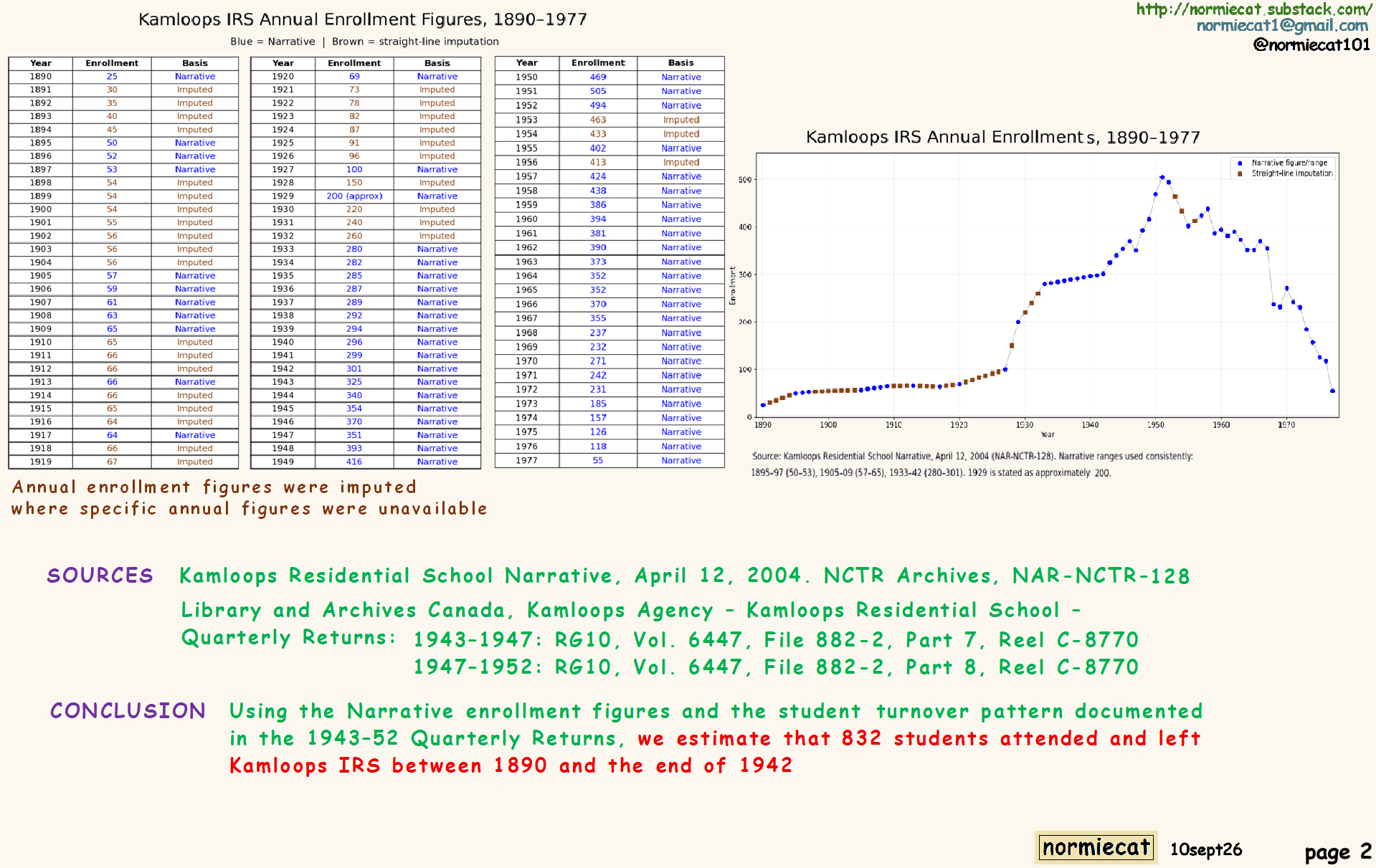
Unfortunately, the surviving attendance records for the 1890–1942 period are fragmentary. So the question this article asks is: using the known enrollment figures from the 1890-1942 period and the student-turnover pattern documented in the continuous 1943–52 Quarterly Returns, approximately how many distinct students attended and left the Kamloops Indian Residential School before 1943?
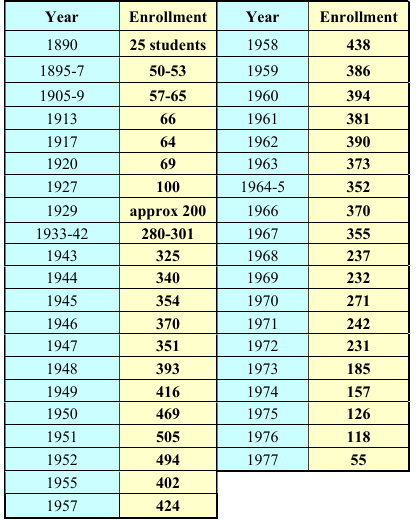
The fragmentary nature of the pre-1943 attendance records is evident in the following table of General Enrolment Statistics found in the Kamloops Indian Residential School Narrative prepared by the federal government (see the National Centre for Truth and Reconciliation (NCTR) copy, NAR-NCTR-128, pp. 7-8).
The explanatory note in the School Narrative states that the enrolment statistics are ‘based on Quarterly Returns where possible’, again indicating that the federal government has quarterly returns for the Kamloops Indian Residential School which it has not made publicly available.
GENERAL ENROLLMENT STATISTICS (most are September figures for each year and based on Quarterly Returns where possible):
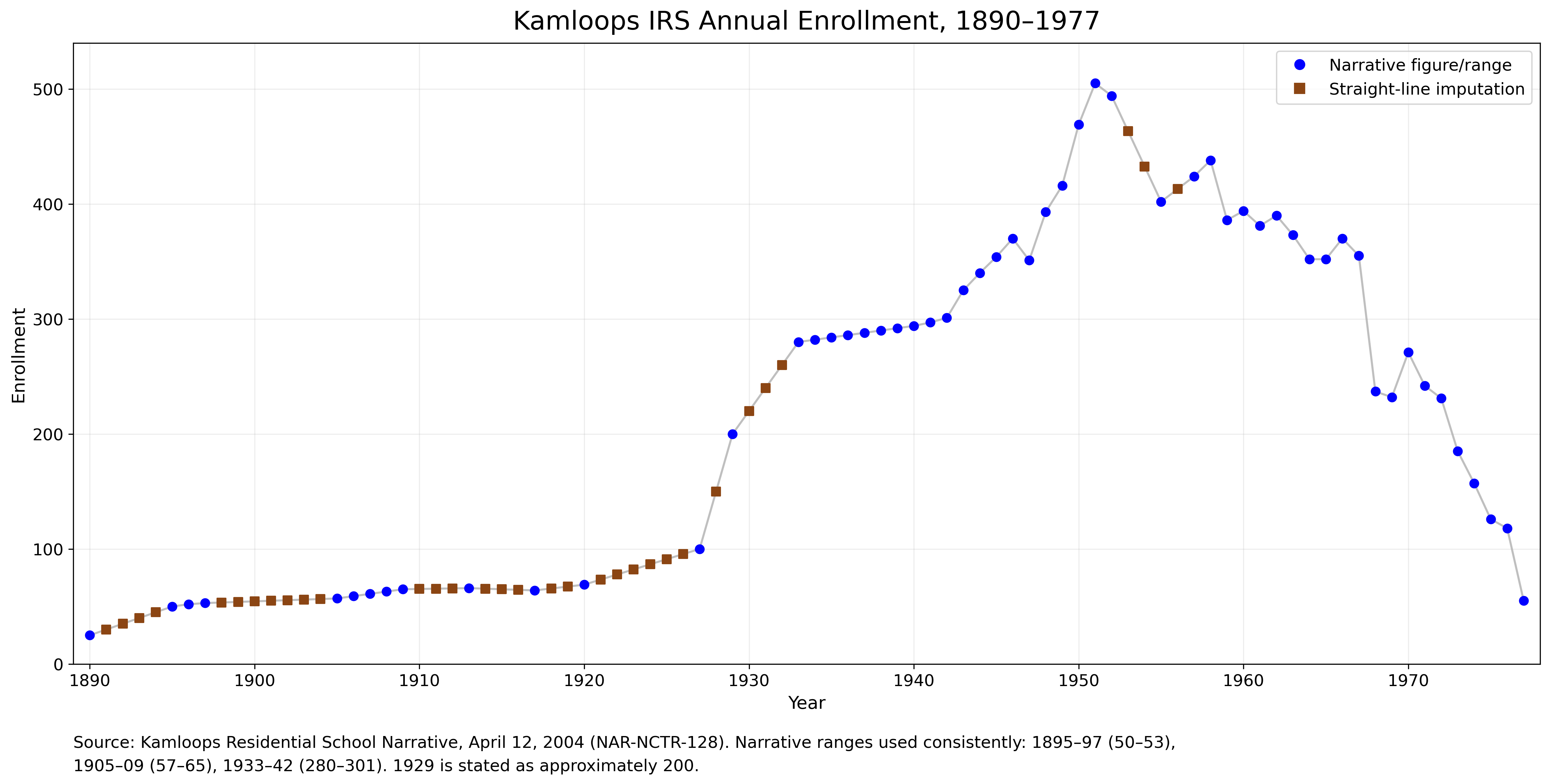
Graphing these numbers gives the following picture. Narrative enrollment figures are shown in blue, with straight-line estimates for the intervening years shown in brown. Before 1943, annual enrollment rose from just 25 students in 1890 to about 300 by the early 1940s.
As noted above, between January 1943 and September 1952, the Quarterly Returns identify 980 distinct students who attended the school. Of these, 290 had entered before January 1, 1943, leaving 690 distinct new students who entered between January 1943 and September 1952.
Relative to annual enrollment, this represents an average annual new-student arrival rate of approximately 20%, allowing for the fact that the 1952 records end on September 30. The observed annual departure rate averaged about 14.7%.
Reconstructing the Missing Years
Using the figures from the School Narrative and the above straight-line interpolations, the eight pre-1933 gaps imply annual arrival rates as follows:
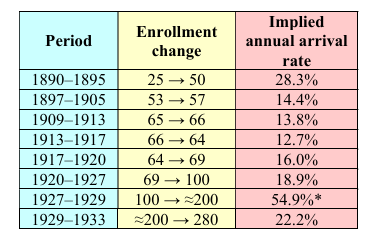
*The unusually high 1927–29 rate coincides with construction of a new school building in 1929, including dormitories, classrooms and recreation rooms.
The weighted average of those eight periods is 20.0% — remarkably close to the approximately 20% annual new-student arrival rate observed in the Quarterly Returns for 1943–52. This close correspondence provides a reasonable basis for reconstructing annual student turnover from 1890 to 1942, as shown below.
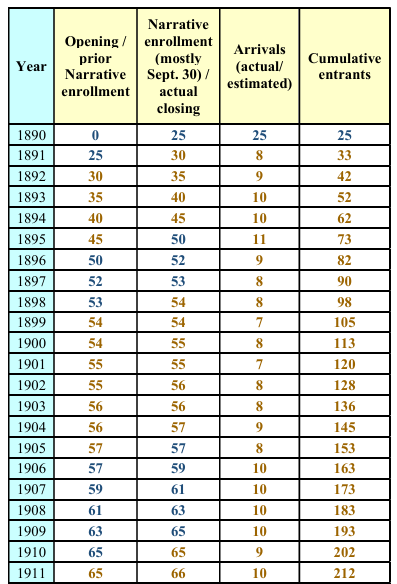
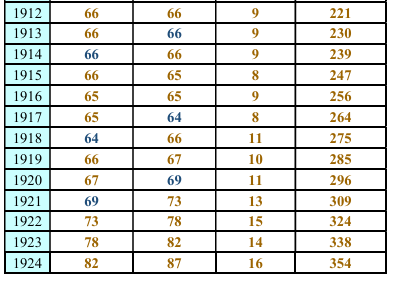
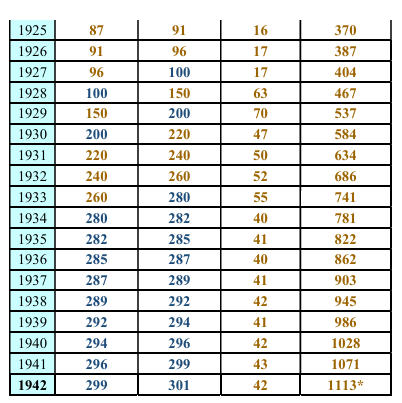
*Because annual estimated arrivals are rounded to whole students, the displayed annual figures sum to 1,113. The underlying unrounded calculation more correctly gives an estimated cumulative total of 1,111.
Putting 215 in Perspective
The 1943–52 Quarterly Returns identify 290 students whose entrance dates were before January 1, 1943, and none shows a pattern of unexplained disappearance while appearing in those records. Subtracting those 290 from the estimated 1,111 cumulative entrants leaves an estimated 821 students who passed through the school between 1890 and 1942 and who had left before January 1943.
This number provides context for the alleged disappearances. If the 215 children announced in 2021 were drawn from this pre-1943 population of approximately 821 students, more than one in four would have had to disappear! That would represent an extraordinarily high proportion, particularly when contrasted with the absence of any comparable pattern of unexplained disappearances among the 980 distinct students identified in the continuous 1943–52 Quarterly Returns.
In testimony before the Standing Senate Committee on Indigenous Peoples on March 21, 2023, Kimberly Murray, then Independent Special Interlocutor for Missing Children and Unmarked Graves and Burial Sites Associated with Indian Residential Schools, offered a different perspective on what “missing” can mean. Murray stated: “The children aren’t missing; they’re buried in the cemeteries. They’re missing because the families were never told where they’re buried.”
That explanation may be more plausible than unexplained disappearances, although Murray’s broader assertion that families were never told where their children were buried is contradicted by at least some surviving burial records. That issue deserves separate examination.
Conclusion
For the three periods under consideration, the evidence does not support a claim of 215 missing students.
During the years 1890-1942, our reconstruction establishes that one in four students would have had to go missing during this period to account for ‘the remains of 215 children’ the Kamloops Band claimed to have found. That no one would notice that one in four students had gone missing seems impossible.
The Quarterly Returns for the years 1943-1952 indicate that no students went missing during that decade.
Many students are still living who attended from 1952 until the school’s closure in 1977, yet none came forward during the RCMP investigation during the years 1995-2003 or at the TRC hearings in Kamloops in 2013 with claims of missing children or clandestine burials. There are thus no credible accounts from surviving students from this period of missing children and clandestine burials.
The surviving records do not tell us what lies beneath the Kamloops orchard. Only physical investigation can do that. But they raise a fundamental question: can the original claim of 215 missing children be reconciled with what the school’s own attendance records tell us? On the evidence examined in this analysis, our answer is a resolute “no.”
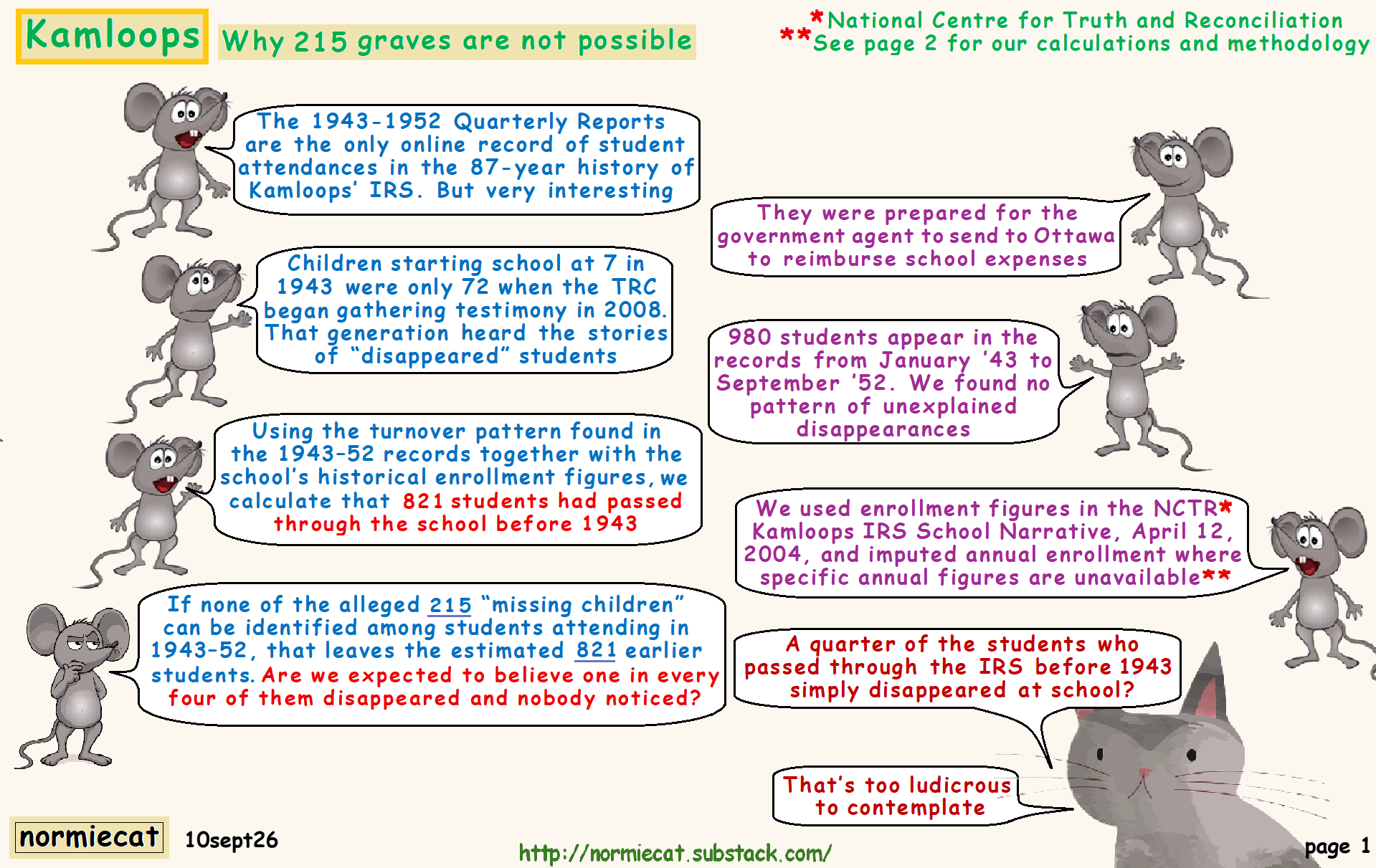
Below is an illustrated commentary summarizing this article. Other commentaries can be found at “normiecat.substack.com” and “@normiecat101”.
Thanks for reading. For more from this author, read Why is the federal government trying to prevent Canadians from learning the truth about Indian residential schools?
Follow Woke Watch Canada on X: @WokeWatchCanada
Or, by contributing to our Donor Box:
There is so much negligence in all of this. The RCMP for one, the Indian officials in that area for two and finally the federal government. Trudeau and Marc Miller did everything they could to give this outrageous story legs. And to this day none of the local government agencies want to take up this issue and put an end to it. The Indians smugly sit back and promote the lies hoping that the free money from Canada's hard-working taxpayers keeps flowing in.
I see you are into things like “facts.” Facts do matter. So does the ability to counter non-facts. I note the Walrus has put out quite the tome on denialism and there is no way to respond. Possibly your folks could investigate their claims in the latest article and send an appropriate note.?
That none of the reserve chiefs who claimed existence of this horror have actually proven a single death that originated in those schools, an apparent crime that was not raised until Spring of 2021 — is instructive. The lack of urgency and the excuses (including the usual cultural ones) are no excuse. Normally accusations of murder is a requirement for proof. Like bodies and such.